

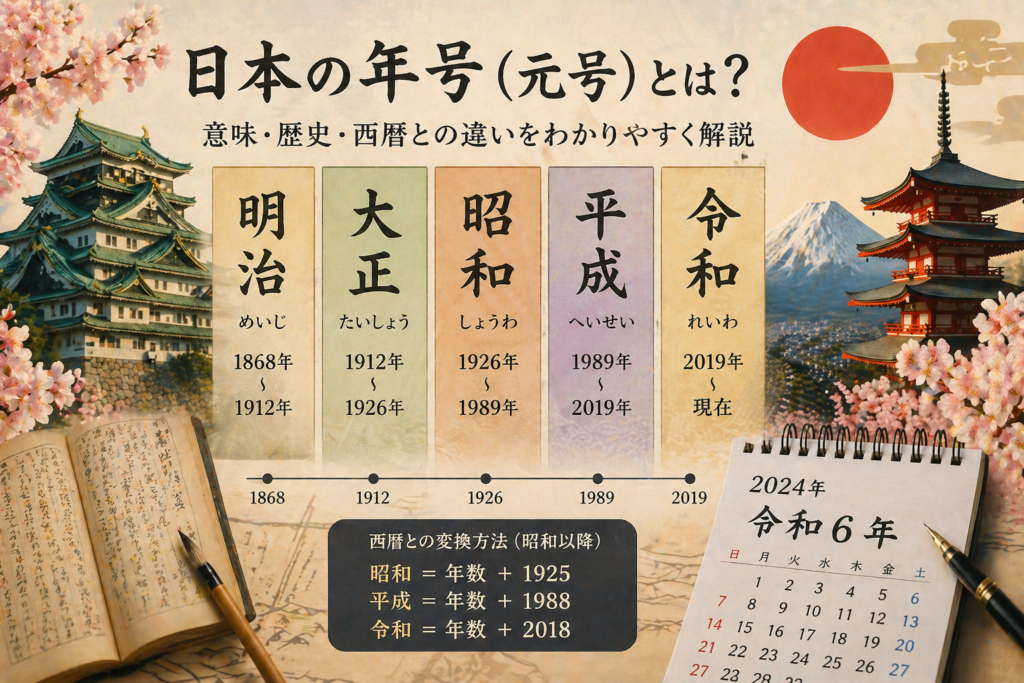
Japan uses not only the Western calendar, but also its own era name system called “gengō.”
For example, the year 2024 is written as “Reiwa 6” in Japan.
This can be confusing at first, but Japanese era names are an important part of Japanese history, culture, and everyday life.
What Are Japanese Era Names?
Japanese era names, known as “gengō,” are used to count years based on the reign of the Emperor.
The current era is Reiwa, which began in 2019.
In Japan, era names are still used in official documents, government forms, driver’s licenses, certificates, and daily conversations.
They are not just numbers; they represent a period of time and the atmosphere of an era.
A Short History of Japanese Era Names
Japan’s first era name is said to be “Taika,” which began in 645.
Since then, Japan has used many era names throughout its history.
In earlier times, era names could change because of major events, disasters, or political changes.
Today, however, the era name changes when a new Emperor ascends the throne.
Modern Japanese Era Names
- Meiji: 1868–1912
- Taisho: 1912–1926
- Showa: 1926–1989
- Heisei: 1989–2019
- Reiwa: 2019–present
How to Convert Japanese Era Years to Western Years
For modern Japanese era names, conversion is simple if you remember the base number.
- Showa year + 1925 = Western year
- Heisei year + 1988 = Western year
- Reiwa year + 2018 = Western year
For example, Showa 50 is 1975, Heisei 10 is 1998, and Reiwa 6 is 2024.
Why Japanese People Feel Familiar with Era Names
For many Japanese people, era names are more than a calendar system.
Words like Showa, Heisei, and Reiwa carry memories, emotions, and images of different periods in Japanese society.
Showa may remind people of postwar recovery, rapid economic growth, and nostalgic everyday life.
Heisei may bring to mind the post-bubble era, the rise of the internet, and major social changes.
Reiwa represents the current era and a new chapter in Japan.
Birthdays and Japanese Era Names
Many Japanese people remember their birth year by era name rather than by Western year.
Expressions such as “born in Showa,” “born in Heisei,” and “born in Reiwa” are commonly used.
In this way, era names are closely connected to personal identity and generational feeling.
Why This System Can Be Confusing for Foreigners
For foreigners, having two calendar systems in one country may feel complicated.
Some forms use Western years, while others use Japanese era years.
However, once you understand the meaning behind Japanese era names, they become a useful key to understanding Japan’s history and culture.
Conclusion
Japanese era names are not just a different way of writing the year.
They are deeply connected to Japanese history, society, and people’s sense of time.
Learning about gengō can help you better understand Japanese documents, conversations, and the way Japanese people think about different generations.