



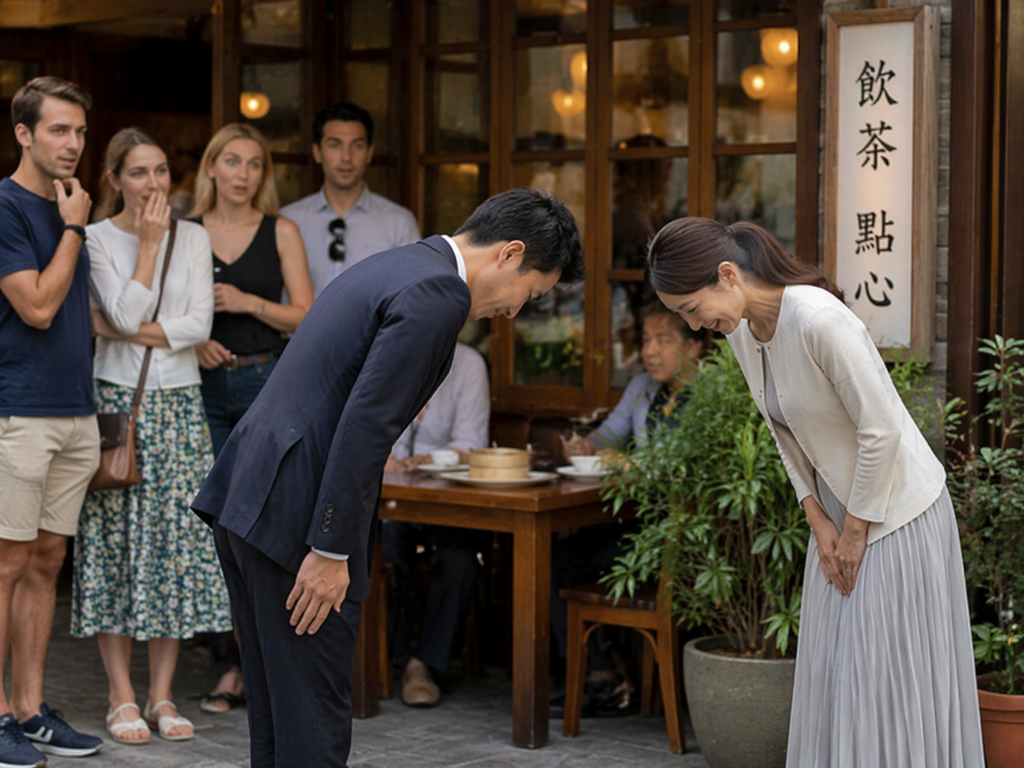
One thing that often surprises foreign visitors in Japan is how often Japanese people bow.
They bow not only when saying hello, but also during conversations and even several times when saying goodbye.
To outsiders, this may seem unusual.
But behind this custom lies a deeper Japanese way of expressing respect, gratitude, and social harmony.
Why Bowing Looks So Unusual to Foreigners
For Japanese people, bowing is a natural part of daily life.
For foreigners, however, seeing people bow again and again can be memorable and sometimes surprising.
Even when acquaintances casually meet in a restaurant or shop, they may bow at the start of the conversation, during polite exchanges, and again when parting.
This repeated gesture can seem mysterious to people from cultures where a single greeting is usually enough.
Bowing Is More Than Just a Greeting
In Japan, bowing is not simply a replacement for saying “hello” or “goodbye.”
It often carries several meanings at the same time.
- Happiness at meeting someone
- Gratitude for past kindness
- Respect for the other person
- A wish to avoid being rude
- A desire to maintain a good relationship
In other words, bowing is a form of nonverbal communication that adds emotional nuance to spoken words.
Why Do Japanese People Bow Repeatedly?
One reason is that Japanese culture often expresses feelings by layering them rather than stating everything directly.
Repeated bowing can add politeness little by little at each stage of an interaction.
This is especially common between people who know each other but are not extremely close.
In such situations, repeated bowing helps maintain the right social distance while still showing warmth and respect.
What Bowing Says About Japanese Relationships
In Japan, maintaining smooth human relationships is highly valued.
Because of this, people often try to avoid causing discomfort or appearing disrespectful.
Repeated bows can be seen as silent messages saying, “I respect you,” “Thank you,” and “I hope we continue to have a good relationship.”
It May Look Funny, but It Comes from Consideration
To first-time observers, repeated bowing may seem curious or even a little humorous.
But behind it is a culture of consideration and thoughtfulness.
If you visit Japan or interact with Japanese people, try paying attention to these small gestures.
They reveal a quiet but meaningful side of Japanese culture.
Conclusion
Japanese people bow many times not simply out of habit, but because bowing expresses gratitude, respect, care, and the wish to build lasting relationships.
Once you understand this, repeated bowing becomes more than a surprising custom—it becomes a window into the Japanese way of thinking and relating to others.