




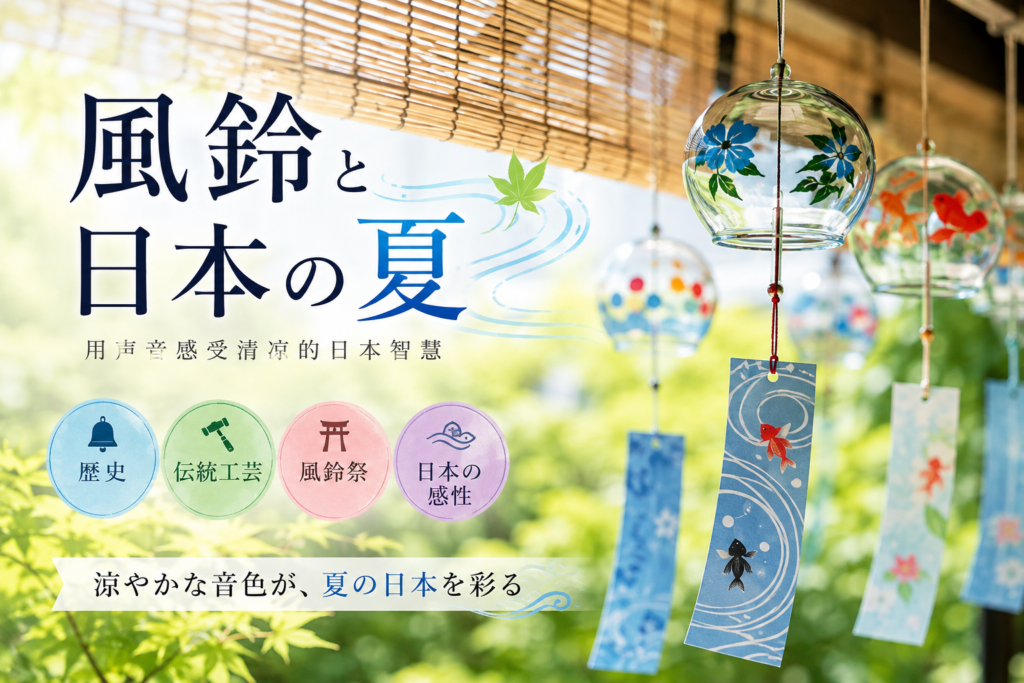
If you visit Japan during the summer, you may hear a gentle “chirin, chirin…” sound drifting through the air.
The sound comes from a furin (Japanese wind chime), one of Japan’s most beloved symbols of summer.
To many visitors, a furin may simply look like a decorative bell. However, for Japanese people, it is much more than an ornament.
It represents a unique way of appreciating nature—by feeling cool through sound.
The History of Furin
The history of Japanese wind chimes dates back nearly 2,000 years.
Their origin can be traced to ancient China, where bronze bells called futaku were hung from temples and important buildings.
People believed that the sound of these bells could:
- Protect against evil spirits
- Bring good fortune
- Keep away misfortune
This tradition reached Japan during the Nara Period (710–794).
At first, wind chimes were found only in temples and the homes of wealthy people. During the Edo Period (1603–1868), however, glass wind chimes became popular among ordinary citizens and eventually became a symbol of Japanese summer.
Why Do Japanese People Feel Cooler When They Hear a Wind Chime?
Interestingly, a wind chime does not actually lower the temperature.
So why do many Japanese people say it makes them feel cooler?
The answer lies in human psychology.
When a wind chime rings, it tells us that a breeze is blowing.
Our brain naturally imagines cool air moving through the space, making us feel more comfortable even if the temperature has not changed.
Before air conditioning became common, people in Japan developed many creative ways to cope with the summer heat.
- Sprinkling water on the ground (uchimizu)
- Bamboo blinds (sudare)
- Hand fans (uchiwa)
- Folding fans (sensu)
- Wind chimes (furin)
Among these traditions, furin is perhaps the most unique because it cools not the body, but the mind.
The Craftsmanship Behind Every Wind Chime
Even today, many Japanese wind chimes are handcrafted by skilled artisans.
The materials, thickness, size, and even the weight of the paper strip hanging beneath the chime are carefully adjusted.
As a result, every wind chime produces its own unique sound.
A furin is not only a practical summer decoration but also an example of Japan’s traditional craftsmanship.
Edo Furin
One of the most famous types is the Edo Furin, which originated in Tokyo.
Each glass wind chime is hand-blown by a craftsman and painted from the inside—a technique that requires exceptional skill.
Typical characteristics of Edo Furin include:
- Handmade one by one
- Painted from the inside
- Soft, gentle tones
- No two pieces sound exactly alike
Popular designs include goldfish, morning glories, fireworks, and watermelons, all of which represent the Japanese summer.
Nambu Iron Wind Chimes
Another famous style comes from Iwate Prefecture and is made using traditional Nambu ironware.
Unlike glass wind chimes, Nambu wind chimes produce a clear, lingering metallic sound that resonates beautifully.
Their elegant tone has gained popularity not only in Japan but also among visitors from around the world.
Wind Chime Festivals in Japan
During the summer, many temples and shrines hold wind chime festivals.
Some of the best-known events include:
- Kawasaki Daishi Wind Chime Market (Kanagawa)
- Ofusa Kannon Wind Chime Festival (Nara)
- Shojuin Wind Chime Festival (Kyoto)
Thousands of wind chimes sway in the breeze, creating a magical harmony of sounds that perfectly captures the atmosphere of a Japanese summer.
Do Other Countries Have Wind Chimes?
Wind chimes and wind bells can be found in many cultures around the world.
However, Japan is unique in using them specifically as a way to feel cooler during the summer.
In many Western countries, the sounds of summer might remind people of birds singing or an ice cream truck passing by.
In Japan, however, the sounds of cicadas and wind chimes immediately bring summer to mind.
This appreciation of seasonal sounds reflects the Japanese way of living in harmony with nature.
Conclusion
A furin cannot lower the temperature.
Yet its gentle sound can make people feel calmer and cooler.
Rather than fighting against nature, Japanese culture has long embraced ways of living with it.
The wind chime is a beautiful reminder that sometimes our senses—and our imagination—can be just as powerful as technology.
If you visit Japan in summer, listen carefully.
You may discover that the soft sound of a wind chime tells a story about Japanese culture that words alone cannot express.