



Some Japanese traditional crafts reveal their true beauty only when you look at them closely.
Japanese lacquerware is a perfect example.
Have you ever seen a glossy black or red lacquer object decorated with delicate golden patterns or shimmering colors that change from blue and green to purple?
Two traditional techniques behind this beauty are maki-e and raden.
The names may be unfamiliar, even to some Japanese people, but once you see the craftsmanship, you may realize that you have seen these decorations before.
What Is Japanese Lacquerware?
Japanese lacquerware is traditionally made by applying multiple layers of natural lacquer, known as urushi, to objects made from materials such as wood.
Urushi comes from the sap of the lacquer tree. Once properly cured, it creates a beautiful surface with excellent durability and resistance to moisture.
For centuries, lacquer has been used in Japan for bowls, trays, chopsticks, boxes, furniture and many other objects.
Maki-e and raden developed as sophisticated ways to make these lacquered surfaces even more beautiful.
Maki-e: Painting with Sprinkled Gold
Maki-e is a decorative technique that developed distinctively in Japan.
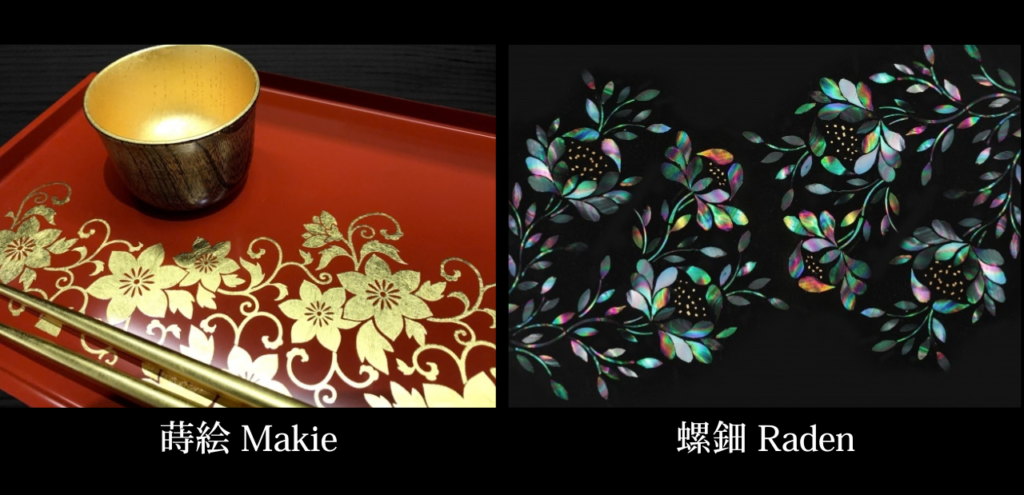
Designs are drawn with lacquer, and while the lacquer is still tacky, fine gold, silver or other metallic powders are sprinkled over the surface.
The word maki-e literally refers to a “sprinkled picture,” describing the way the powder is scattered onto the design.
Traditional motifs often depict flowers, birds, mountains, rivers, clouds and the moon.
Against deep black lacquer, the gold appears to glow. As the viewing angle and light change, the decoration takes on a different appearance.
Different Types of Maki-e
There are several important maki-e techniques.
Hira Maki-e
Metal powder is sprinkled onto a lacquer design to create a relatively flat decoration.
Togidashi Maki-e
The decorated surface is covered with additional lacquer and later polished until the hidden design gradually reappears.
Taka Maki-e
The design is built up to create a raised surface before metallic powder is applied, producing a three-dimensional effect.
Each method reflects light differently and gives the finished work its own character.
Raden: The Rainbow Colors of Shell
Raden creates beauty in a completely different way.
Pieces of shell with lustrous mother-of-pearl layers, such as abalone and other shells, are carefully cut and shaped before being inlaid into lacquerware and other objects.
The most fascinating feature of raden is its changing color.
Depending on the angle of the light, the shell may appear blue, green, purple or pink—as if a tiny rainbow had been captured inside the lacquer.
These colors are not painted. They come from the natural structure of the shell reflecting light.
A Long History of Raden
Shell-inlay techniques have a long history across Asia and were introduced to Japan from the Asian continent.
By the Nara Period, sophisticated raden decoration was already being used in Japan, and precious examples survive among the treasures associated with the Shosoin in Nara.
Over the centuries, the technique blended with Japanese aesthetics and became an important part of Japanese lacquer art.
Combining Maki-e and Raden
Maki-e and raden are beautiful individually, but artisans sometimes combine both techniques in a single work.
Imagine golden maki-e against deep black lacquer, accented by pieces of shell shimmering in rainbow colors.
Black lacquer, glowing gold and iridescent shell.
Together, these different materials create extraordinary depth and richness.
Beauty That Takes Time
Traditional lacquerware cannot be completed with a single coat.
Applying lacquer, allowing it to cure, polishing the surface and applying another layer are repeated many times.
Maki-e and raden add even more detailed work, requiring remarkable patience, concentration and skill.
This helps explain why fine Japanese lacquerware can be expensive: its value lies not only in its materials, but also in the time and craftsmanship invested in every piece.
Maki-e and Raden in Modern Life
Today, these techniques are no longer limited to traditional bowls and boxes.
- Jewelry and accessories
- Fountain pens
- Watches
- Jewelry boxes
- Interior objects
- Contemporary art
Centuries-old techniques continue to meet modern design, creating a new generation of Japanese craftsmanship.
Japanese Beauty Revealed Up Close
If you have an opportunity to see maki-e or raden, take a closer look.
A pattern that appears simple from a distance may reveal countless particles of gold or tiny pieces of carefully shaped shell.
Then change the angle of the light.
The gold begins to glow differently, while the shell changes color before your eyes.
Conclusion
The beauty of Japanese lacquerware is not simply about its shape or color.
Layer after layer of lacquer is applied. Gold powder is sprinkled by hand. Tiny pieces of shell are cut and carefully placed.
Behind the finished object lies the patience, experience and skill of the artisan.
Once you understand maki-e and raden, you may never look at Japanese lacquerware in quite the same way again.
The next time you encounter a beautiful piece, look closely.
A small surface may contain centuries of Japanese craftsmanship.